
Remembering the Holocaust
As part of our events to mark Holocaust Memorial Day, two of our students, Layla Ragless and Sienna West (both 12Story) were selected to participate in the Holocaust Educational Trust’s ‘Lessons from Auschwitz programme’. Here is their moving account of their participation, including a trip to Auschwitz:
Our trip to visit the Auschwitz museum began with an introductory seminar in London, where we could meet the other participants and our group leader. This was a great opportunity to become acquainted with the other people we were going to eventually fly to Poland with. Firstly in the seminar, we had a lecture from one of the organisers who ran us through what to expect from the trip and what we were going to be discussing that day. The focus was primarily pre-war Jewish life, which we found very interesting as it is not something we often talk about. In the A Level specification we begin with Hitler's rise to power and the immediate laws he put in place persecuting the Jews, so it was fascinating to see how they lived prior to this. When we split off into our groups for the day, our leader, Matt, was teaching us about how normal everything seemed before the war. Children went to school, families owned businesses, had homes, had friends and it appeared to be no different to life as we know it. This made the trip so much more impactful as now we had connected to the victims of the holocaust, personalising each individual and giving them more value than just 1 in 6 million. Matt passed around images of families and gatherings, where they were celebrating birthdays, first days of school and weddings. Each person we looked into had their own interests and hobbies that got stripped from them during the horrors they experienced. It was now more obvious than ever that life completely changed for the victims, going from large family gatherings to potentially never seeing each other again. Knowing this, the trip became far more meaningful, as when we stood before the shoes and clothes of those who had been imprisoned, we were able to recognise and appreciate how much was actually lost.
This was then emphasised by the next part of our seminar; the talk with a Holocaust survivor. This was my ‘favourite’ part of the stages given to us by Lessons From Auschwitz because it made everything so much more real. Suddenly, instead of being sat in a classroom in front of a teacher, I was being spoken to by someone who really experienced the well known horror stories we all hear. He told us in depth about his upbringing, the separation of his family, the camps, homes, casualties, soldiers, rescuers and reuniting with his cousins. His story was so moving, and he was proud to share everything from maps and statistics, to pictures of him and his mother. Hearing about his life helped to prepare us for what was inevitably going to be a heart wrenching day, and I was sure to keep it in mind as we left for Poland in the morning.
We started our day at 2am when we left for the airport, unsure on what the day would bring but prepared for whatever emotions it could uncover. When we arrived at Auschwitz One we were taken into the entrance of the museum and given headphones for the guided tour. At first it all felt surreal, having flown to Poland and on the same day that we were lying in our beds in the comfort of our homes, now being stood in a place where so many never had the privilege of leaving. As we left the entrance of a rather comfortable building and began walking towards the Barracks, the names of every known victim were being read aloud. No music, no speaking, just the solemn remembrance of those who suffered finally having their name shown to the world. The names being read aloud was the first of many moments in this day that the scale of this genocide was put in perspective, just to think that every name being read was a person with a family, hopes and dreams that were never lived out, truly moved us.
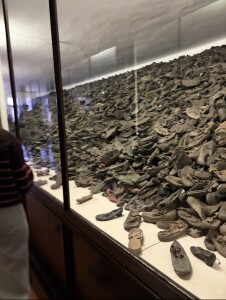
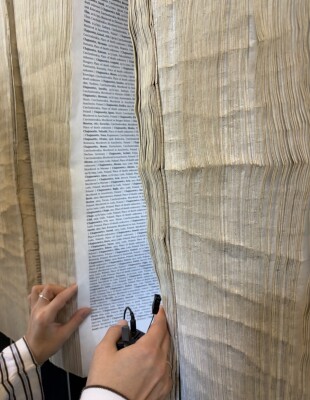 Following this walk we arrived at a large area where in front of us stood the gates to what previously was the entrance to this camp. On the gates it read ‘Arbeit Macht Frei’ which translates to work sets you free. This message alone demonstrates the pure hypocrisy and lies that the Nazi Party fed the victims of Auschwitz, as what freedom were they truly achieving. We then moved onto a block dedicated to Jewish life. Inside a Rabbi who was on the trip spoke to us about the importance of seeing these Jewish victims as real people with real lives. The first room in this converted Barrack held a book of names, the names of every victim at Auschwitz. You hear about how many people suffered but actually seeing it, 4,800,000 names is unimaginable. This moment was almost the most difficult sight to see in our day trip as you truly cannot fathom how many suffered until you are staring it in the face. Another harrowing part of this camp was the Barrack that was completely untouched, the conditions these people were kept in was horrific and knowing that we were stood in a building where such atrocities took place left us speechless with nothing but the irony of knowing I was free to leave, mixed with anger towards those who were in charge and sadness for those who did not survive and endured unimaginable pain. The Barrack that moved us most was the one which held shoes, glasses, suitcases, prosthetics and even human hair. When we walked into the room with shoes we were desperately taken aback, shocked at just how many shoes were in front of us. Every pair had an owner, a story, an occasion and here they were in front of us. So many shoes. It ranged from heels to trainers and sandals; some belonged to what looked like toddlers. When we left this Barrack and walked outside, we couldn’t help but think of those who were unable to walk out in their shoes and leave that horrifying building. Our next building was a gas chamber used by the Nazis, which could be seen from the house of the man who oversaw this camp. We genuinely cannot put into words what standing inside a gas chamber and looking up at the holes within the ceiling from where they dropped the gas feels like. Some of the walls were stained from the Zyklon B gas used. Again, when we left the gas chamber and saw the door behind us, we couldn’t help but think of the thousands of people who never got to see this side of the door.
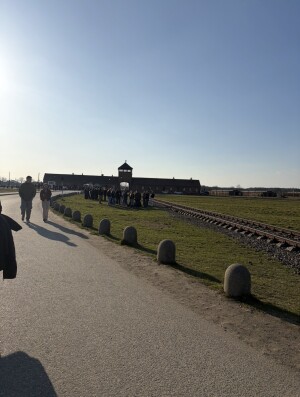
 From here we left this camp and took a short coach journey to Auschwitz Birkenau. The entrance to this camp was menacing, the depiction of the railway into the camp was a picture we had seen many times, in lessons, videos, our phones and in research but witnessing it in real life was so much different and made the entire thing seem a hundred times more real. In this camp were Barracks, nothing more than gas chambers and a memorial. Just rows upon rows upon rows of unhygienic, soulless wooden huts. Outside one of the Barracks the Rabbi gave a speech about the humanity of Jewish people in Auschwitz. It is truly moving to hear about the humanity that occurred amongst a place that could not lack any more humanity, a true warming yet agonising juxtaposition. Our final building of the day was a washhouse located next to the destroyed gas chamber. Inside was almost fully converted and was full of photographs of Jewish victims prior to the Holocaust. We cannot describe how we felt witnessing the moments of joy which we knew would turn into torture, yet we’re certain that a smile crossed our faces in witnessing the pure life many of those who died once lived. It was in this building that we were lucky to hear from the daughter of an Auschwitz survivor, a truly emotional, once in a lifetime experience where the perspective of the Holocaust and Auschwitz was brought into reality by the story of a father who had a daughter. It was from here that we walked to the memorial procession where we heard a Jewish prayer in Hebrew, and poem of a survivor, about those who died at Auschwitz. After this we made our way back to the coaches. We both took one glimpse back at the railroad where people were treated like animals, if not worse and felt a sheer sense of irony, hypocrisy, sadness and anger.
As the sun set over a place that should never have been created, we couldn’t help but feel lucky that we were able to leave and were left only imagining how it felt to be trapped in that place for what must have seemed like their eternity.